Three tokenized deposit networks formed this quarter. Community banks are barely at the table.

If you run technology, digital, or the balance sheet at a community bank, the last four months have been strange to watch. Everything you were told was speculative is now being built by the largest institutions in the country, and community banks are barely represented among the institutions visibly setting the standards.
Look at the calendar.
On April 7, the FDIC proposed a rule stating that deposit insurance does not depend on the technology used to record a deposit. On June 5, The Clearing House announced a bank-led on-chain money initiative with seventeen named institutions including JPMorgan, Bank of America, Citi, Wells Fargo, PNC, Truist and U.S. Bank, to clear and settle tokenized deposits between banks. On June 30, a consortium of more than 140 companies including Visa, Mastercard, Stripe, BlackRock, Coinbase and BNY announced Open USD, a shared digital dollar that institutions participate in as distributors. And running quietly underneath all of it, the Cari Network, founded by a former Comptroller of the Currency, launched an MVP in March and is now preparing a pilot with six design partner banks, having expanded to more than thirty participating banks.
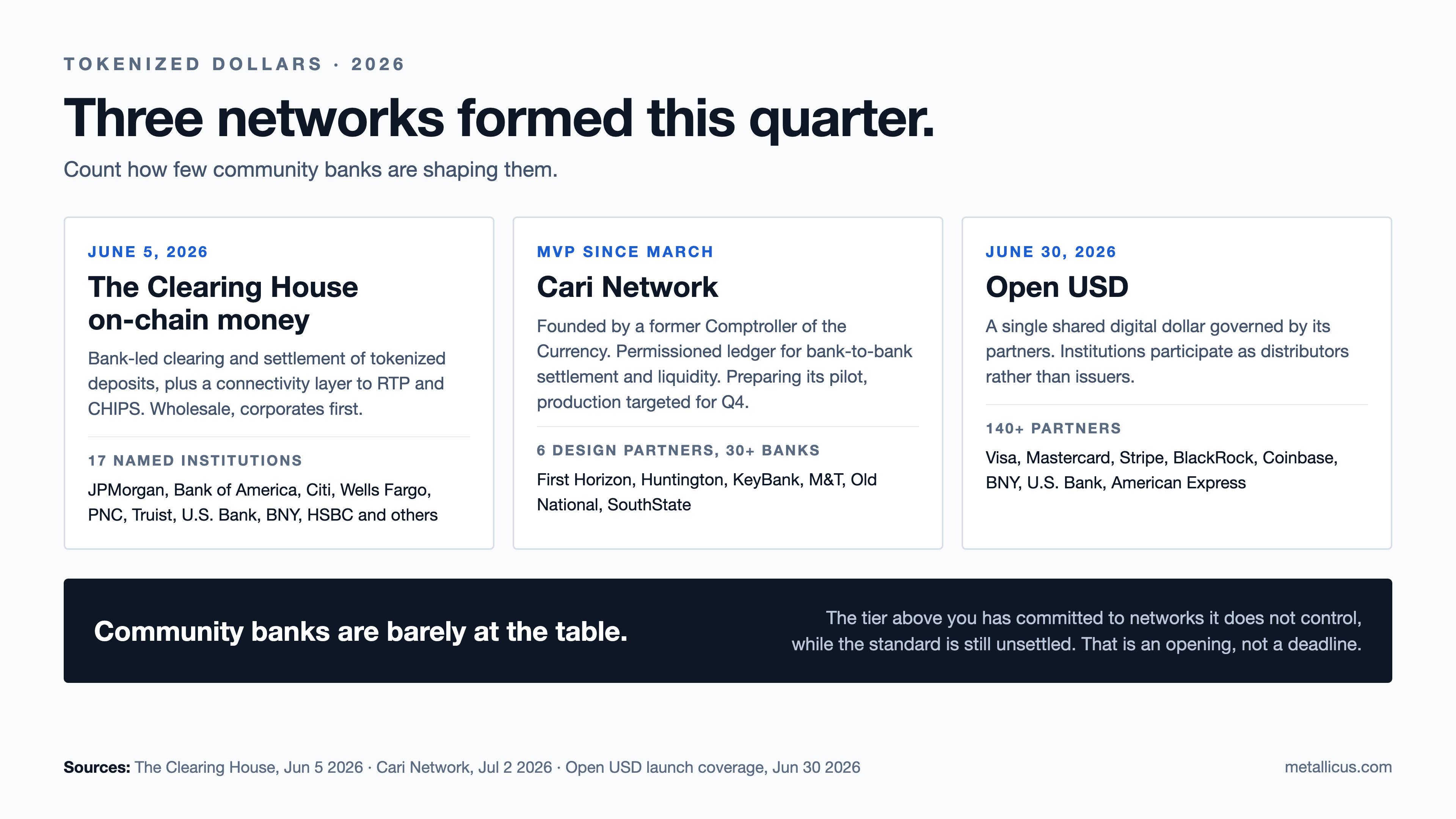
Four major developments in under four months. Now count how few community banks are shaping them.
That is not a reason to wait. It is the reason not to.
Three terms, two instruments
Most of the confusion in this market comes from three things wearing the same clothes.
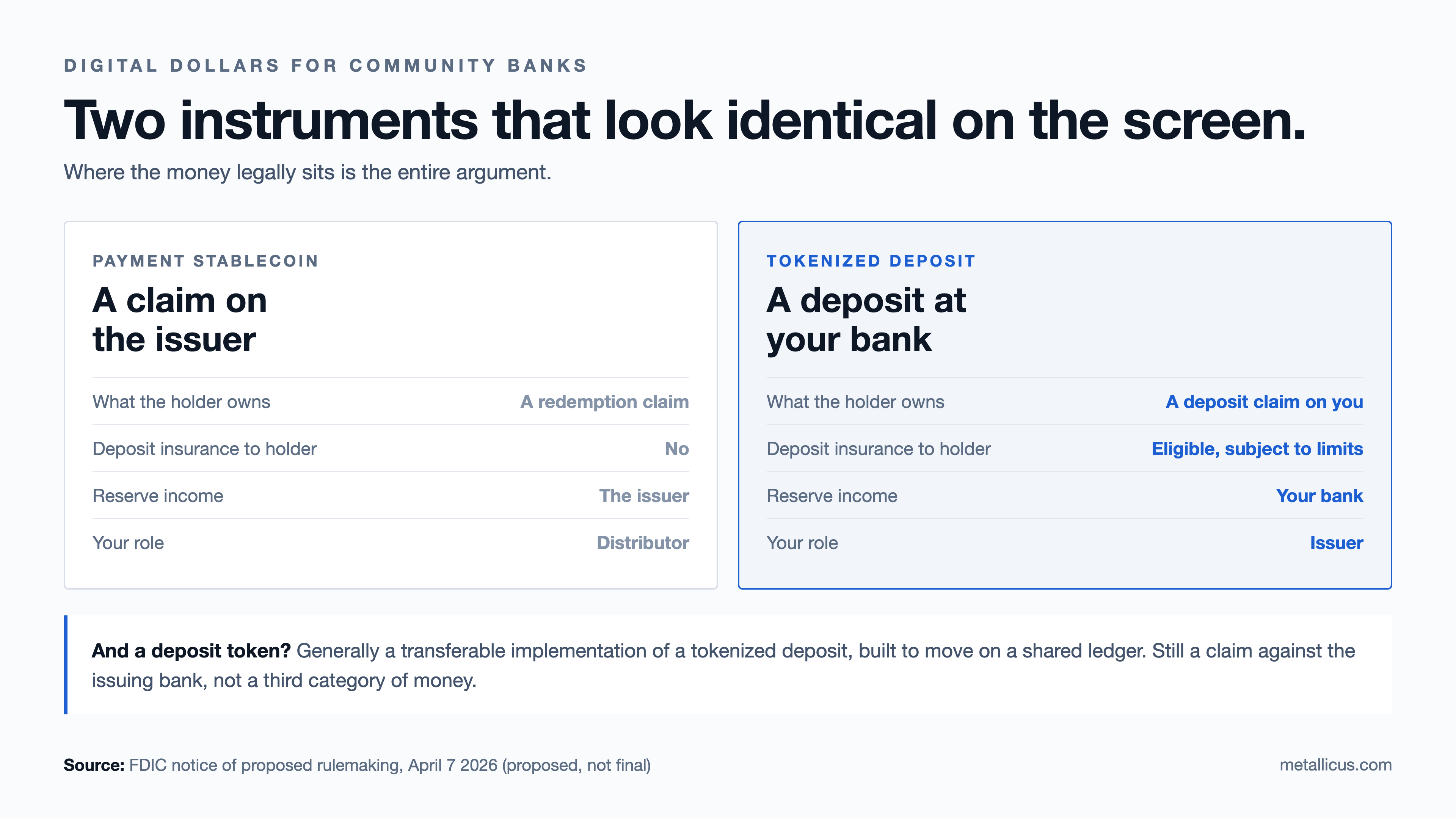
A payment stablecoin is a redemption claim against its issuer, backed by the issuer's reserve assets. It ordinarily is not a bank deposit and is not FDIC-insured to the holder. When your customer buys one, the dollars leave your balance sheet and the reserve income accrues to the issuer.
A tokenized deposit is a bank deposit represented on a programmable ledger. Provided it meets the statutory definition of a deposit, the underlying legal claim remains a deposit liability of your bank. The customer still holds a claim on you, and you still fund your loan book with it. What changes is what the money can do: move in seconds, carry conditions, settle at the same instant as the asset it pays for.
A deposit token is generally a transferable implementation of a tokenized deposit, designed to move on a blockchain or shared ledger. It is still a claim against the issuing bank rather than a separate category of money.
The distinction is the whole argument. The first shrinks your bank. The others modernize it.
There is a detail in the FDIC's April proposal that makes this concrete, and it deserves more attention than it has had. The proposal would confirm that tokenized deposits meeting the statutory definition of a deposit are treated no differently than any other deposit, insurance included. It also states that reserves backing a payment stablecoin are not pass-through insured to the people holding that stablecoin.
Read those together and the customer-facing difference is stark. A tokenized balance that meets the statutory definition of a deposit at an FDIC-insured bank remains eligible for deposit insurance under the ordinary ownership rules and applicable limits. A stablecoin in the same customer's wallet is a redemption claim against its issuer, backed by that issuer's reserves. Same screen, same dollar sign, different answer when something breaks. That is worth explaining to your commercial customers before somebody else explains their version to them.
What deposit flight actually looks like

The mechanics matter more than the abstraction, so here they are.
A commercial customer moves two million dollars into a major stablecoin so supplier payments settle faster. Three things happen at once. Your deposit base and liquidity fall by two million, and unless that funding is replaced, your capacity to fund lending declines or the cost of funding it rises. The reserve income on that two million now accrues to the issuer rather than to you. And the payment activity that used to tell you what that business was doing, and when it might need credit, becomes far harder to see.
None of that requires your customer to be unhappy with you. That is what makes it dangerous. It requires only that the alternative is faster.
You are late to the announcements, not to the market
Here is the part the headlines obscure.
As of July 30, 2026, no insured US depository institution has publicly announced that it is issuing a payment stablecoin under a final GENIUS Act approval. JPMorgan's JPMD is a deposit token rather than a stablecoin. Bank of America has stated an intention on an earnings call, with no product and no date. Wells Fargo has filed a trademark. Schwab says it is exploring. The June 5 Clearing House announcement did not identify a technology vendor or publish a finished rulebook, and subsequent reporting places the target launch in the first half of 2027.
Meanwhile the mid-size banks are hedging visibly. Huntington appears in all three announced networks, while Citizens, KeyBank and U.S. Bank each appear in two. Institutions with far more resources than yours are refusing to bet exclusively on one standard, because nobody knows which one wins.
So the honest position is not that you are behind. It is that the tier above you has committed to networks it does not control, while the standards question is still open. That is a better place to be starting from than it looks.
What you actually need in order to issue
The instinct when a bank first takes this seriously is to ask what it would have to build. The honest answer is that no community bank should build any of it. What matters is knowing the parts, so you can tell whether someone is selling you the whole thing or a fragment of it.
Issuance and redemption. A token your customers buy from you and redeem back into an account at your bank. The round trip is what keeps the deposit in the building.
Funding that stays with your institution. This is the point of the exercise, and the answer depends on the structure. Ask specifically whether what you are issuing is a tokenized deposit that remains your deposit liability, or a payment stablecoin issued through a separate entity, because the balance sheet and accounting treatment differ. If the model routes reserves to the vendor, you have bought a stablecoin with your logo on it.
Identity at the protocol layer. Ask whether identity and transaction permissions can be enforced at the protocol layer, so a deployment can require verification before value moves, or whether identity is bolted on afterwards as monitoring. The difference is whether you are preventing prohibited transactions or discovering them later. Your compliance team will care about this more than any other answer on the list.
Custody and customer experience. Somebody has to hold assets and give customers somewhere to use them. If the answer involves your bank operating a crypto exchange, walk away.
A network. A dollar only your own customers can use is a gift card. Your token has to interoperate with other institutions' tokens, which makes the standard more important than the software.
A path from pilot to production. Most of what is announced in this market is a pilot that never ships. Ask what is running in production today, and ask to see it.
Those six questions are worth taking into any vendor conversation, including one with us.
Where we fit, plainly
We build the infrastructure that lets a bank or credit union issue its own branded digital dollar, backed by reserves on its own balance sheet, and join a network where institution-issued dollars interoperate.
That network runs on Metal Dollar, or XMD, a digital dollar fully backed by a basket of regulated stablecoins including USDC, PYUSD and USDP. XMD is live in production today rather than a roadmap item. New reserve assets are added through public on-chain governance rather than a private decision by us, and institutions can propose their own stablecoins into that basket. That mechanism is the difference between an institution's dollar being part of a shared standard and being an island.
Underneath it we run our own chains, so a bank is not renting space on infrastructure designed for something else, and deployment can be public, private or hybrid, which matters because a board's first question is usually about what is visible to whom. Identity and permissions can be enforced at the protocol layer rather than added afterwards, so an institution-controlled deployment can require verification before value moves. There is an API for institutions that want payments and digital asset access with no customer-facing change, white label trading and wallet infrastructure for those that want the experience under their own brand, and digital asset lending on the same rails.
What we do not offer is a way to skip the hard parts. There is no version of this where a bank issues a digital dollar without its compliance function being deeply involved, and any vendor suggesting otherwise is selling you a future examination finding.
What is honestly unresolved
Three things, said plainly, because you will find them anyway.
The regulatory picture is better and not finished. The FDIC's April action was a proposed rule, not a final one, and it remains unfinished as of today. Anyone citing it as settled law is overreaching.
Adoption is uneven. Several of the new consortium networks remain pre-production, while JPMorgan and Citi already operate live institutional tokenized-deposit and blockchain-payment products. Public disclosure of volumes and customer usage remains limited, particularly outside the largest banks.
And the standards question is open. Whether the institution-issued model, one of the consortium models, or something not yet visible ends up winning is genuinely unknown. What is already clear is the direction, and direction is the only part a board needs in order to act.
The question for your next board meeting
Not whether to do crypto. That question is a decade old and was always the wrong one.
The question is narrower. When your customers can hold dollars that move instantly, whose balance sheet do those dollars sit on? The institutions answering that right now are answering it for themselves, and the version where you participate on your own terms has a shorter runway than the version where you wait.
The infrastructure exists. The legal framework is arriving. What is scarce is time, and the willingness to be early in a market where being second looks a lot like being absent.
If you want the detail behind any of this, my inbox is open, and I will answer the awkward questions as readily as the easy ones.